


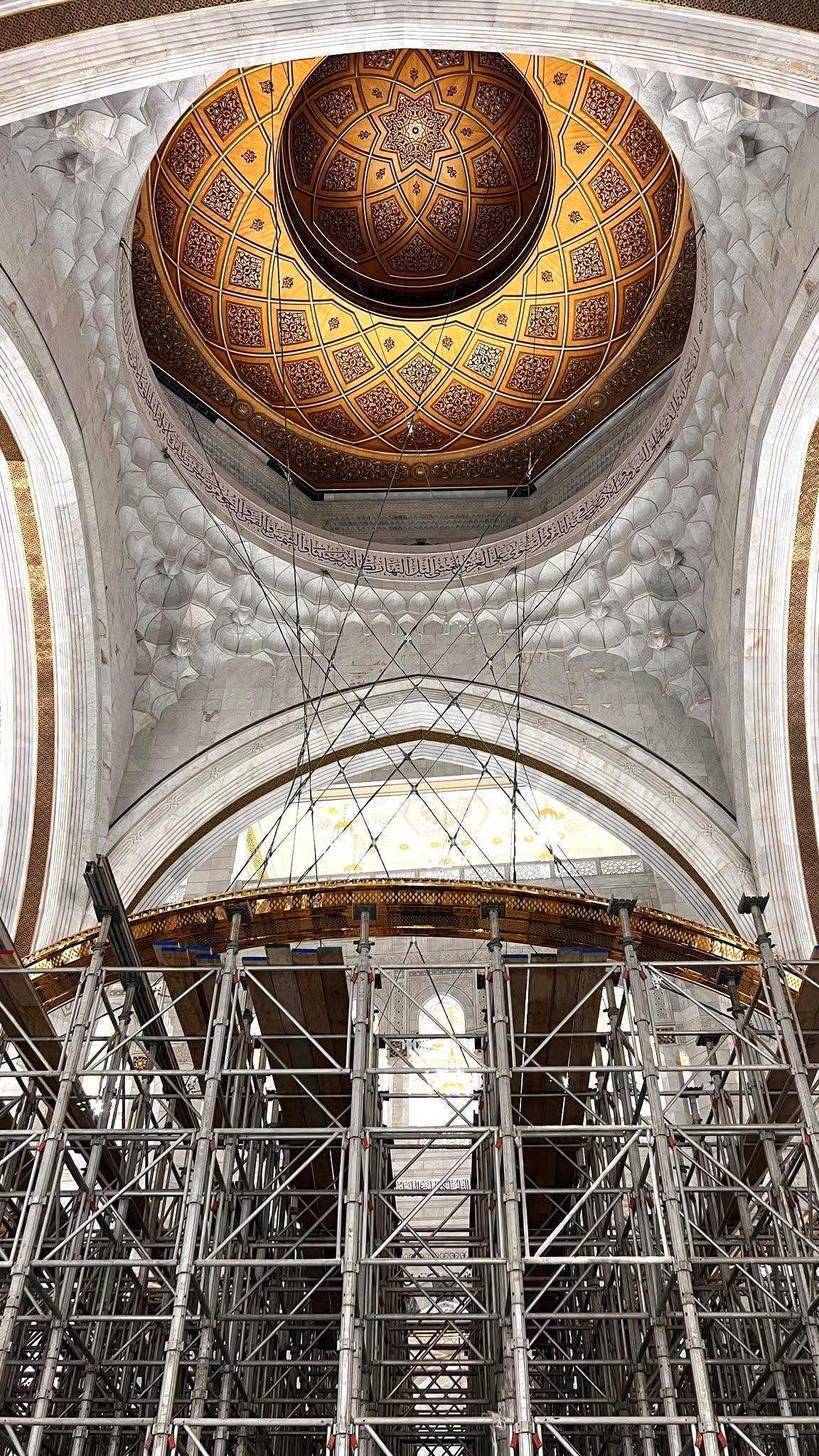


A Chandelier for the Grand Mosque in Mecca
96,120 LED points, 34.1 metres in height, around 12 kilograms of gold: for the first time, Lights of Vienna is sharing details and images of one of the world’s largest chandeliers – designed and built in Guntramsdorf near Vienna.
The chandelier in the Grand Mosque in Mecca (al-Masjid al-Haram) is the centrepiece of the Third Saudi Expansion in the Shamiya area and the result of around ten years of planning and development. Consisting of two gold-plated rings up to 17.8 metres in diameter, it stands 34.1 metres tall, weighs 18.4 tonnes and ranks among the largest chandeliers of its kind. It was designed and manufactured in Guntramsdorf near Vienna.
“A project of this magnitude requires far more than exceptional design. What matters is precision in manufacturing, years of planning and the ability to deliver reliably under the most demanding logistical conditions. That a team of 33 people in Guntramsdorf was able to realise a project of this scale in Islam’s most significant building shows what Austrian specialist manufacturing can achieve,” said Alexander Oborny, Managing Partner of Lights of Vienna.
Lighting technology
96,120 LED points generate more than 4.75 million lumens at a power consumption of 29,862 watts – one of the highest light outputs ever achieved in a chandelier. 1,000 electronic drivers, 96 power circuits, 56 control circuits and around 19.7 kilometres of cabling allow flexible control and even illumination. Lighting and cooling technology are integrated directly into the ring segments. The system is designed for 24-hour operation and a service life of at least 50,000 hours at ambient temperatures of up to 50 °C.
Millimetre precision on a monumental scale
The greatest manufacturing challenge was the inner and outer ring segments: despite their size, every component, including the surface coatings, had to be produced with millimetre precision. Around 12 kilograms of gold were applied in a layer thickness of 0.5 micrometres. For assembly, Lights of Vienna developed its own rotating and mobile support systems, on which each segment was fitted with gold plating, decorative elements and integrated lighting and cooling technology. Thousands of components were integrated and tested to strict quality requirements – all at the company’s facility in Guntramsdorf, by a team of 33.
The real challenge was not the size alone, but the combination: almost 100,000 LED points, cooling technology and gold plating had to be integrated into segments that fit to the millimetre despite their dimensions. Combined with continuous operation at up to 50 °C, every detail – from cable routing to heat dissipation – had to be considered from the very beginning.
Logistics and installation
To meet the schedule, the entire chandelier was flown from Linz to Jeddah in nine air freight consignments plus a dedicated Boeing 747 charter organised by cargo-partner – broken down into ring segments and packed in 38 transport crates, with a total cargo weight of 48 tonnes. On site, partners of Lights of Vienna assembled the chandelier over several months.
Long-standing presence in Mecca
The Third Saudi Expansion in the Shamiya area is the largest in the history of the Grand Mosque. Located north of the historic mosque, it has raised the mosque’s capacity to around 1.85 million worshippers. Lights of Vienna supplied all the luminaires for this area: between 2011 and 2016, more than 4,450 luminaires and chandeliers. In 2025, the company also completed the Mataf project with 550 luminaires, the largest of them ten metres tall. With the chandelier under the central dome, more than three times that height, Lights of Vienna now completes its work in the Shamiya area. The project also strengthens the company’s long-standing partnership with the Saudi Binladin Group, one of the largest construction companies in the region.
Fact sheet
Feature | Value |
|---|---|
Location | Grand Mosque (al-Masjid al-Haram), Mecca – central dome, Third Saudi Expansion, Shamiya |
Planning and development | around 10 years |
Height / diameter / weight | 34.1 m / 17.8 m / 18.4 t |
Gold plating | around 12 kg of gold, 0.5 µm layer |
LED points | 96,120 |
Luminous flux / power | over 4.75 million lumens / 29,862 W |
Electronics | 1,000 drivers, 96 power and 56 control circuits, around 19.7 km of cabling |
Operation | at least 50,000 hours, up to 50 °C, 24/7 |
Manufacturing | in Guntramsdorf, Austria, 33 employees; glass and electronic components from specialist suppliers |
Transport | 9 air freight consignments plus Boeing 747 charter flight (cargo-partner), Linz–Jeddah, 38 crates, 48 t |
Previous projects in Mecca | Shamiya 2011–2016 (over 4,450 luminaires and chandeliers), Mataf 2025 (550 luminaires) |