




Design in Transition by Lights of Vienna: How Artificial Intelligence Is Transforming Design and Architecture
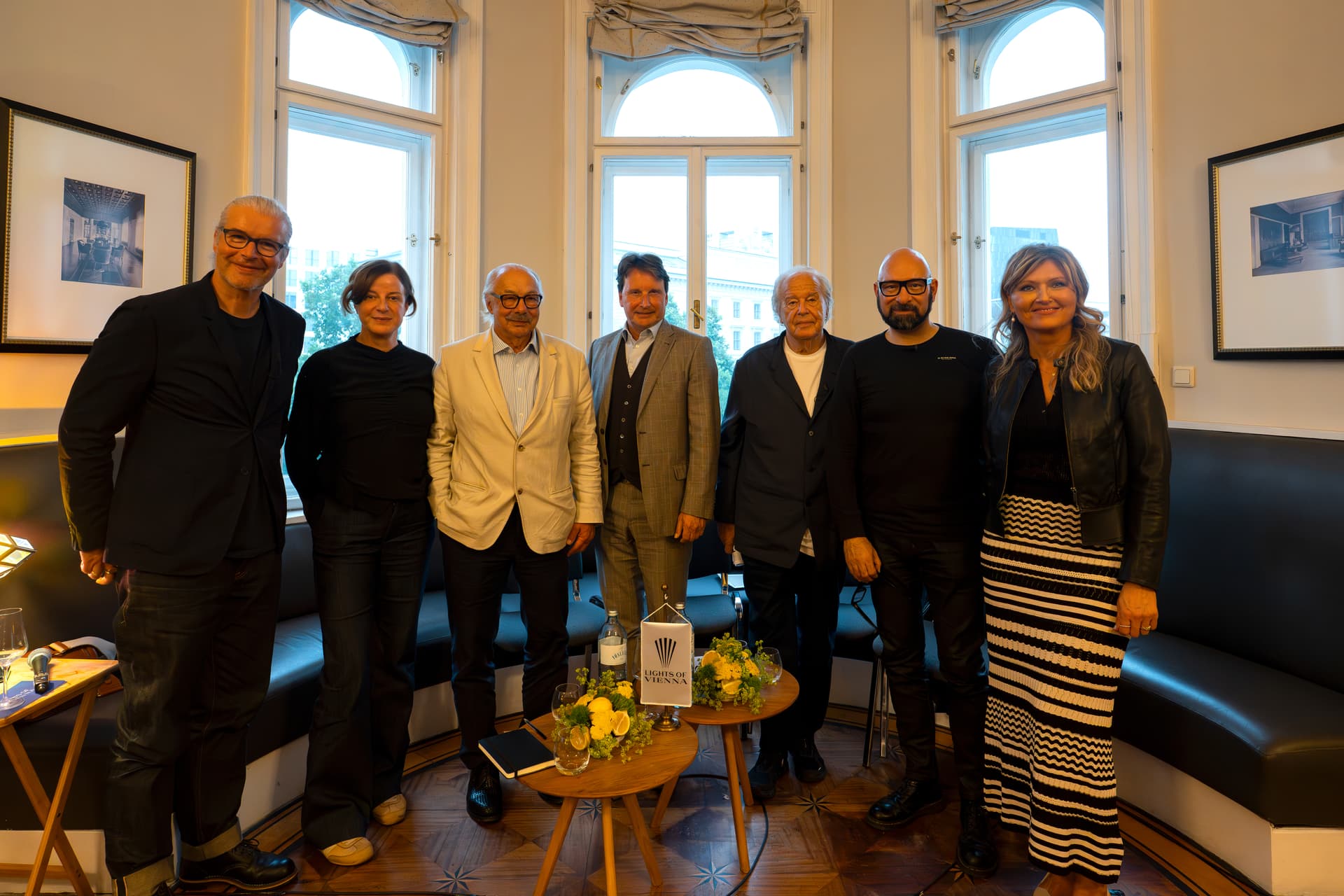
As part of the second edition of Design in Transition by Lights of Vienna, a panel of experts including Matias del Campo, Thomas Feichtner, and Boris Podrecca explored the impact of artificial intelligence on design, architecture, and creative processes. Among the more than 80 guests were fashion designer Atil Kutoglu, artist Elisa Alberti, ballerina Rebecca Horner, designer Tino Valentinitsch, and numerous representatives from the fields of art, culture, design, and architecture.
Vienna – How is artificial intelligence changing the way we design, create, and produce? What role will humans play in future creative processes? And is generative AI giving rise to a new visual language? These questions were at the heart of the second edition of the event series Design in Transition by Lights of Vienna, which took place yesterday evening at the Bridge Club in Vienna under the title “Generative AI and the New Logic of Form.”
The panel was as distinguished as it was engaging. Moderated by Martin Traxl, architect and AI researcher Matias del Campo, internationally renowned architect Boris Podrecca, and industrial designer Thomas Feichtner discussed the profound changes that generative AI is currently driving in architecture, product design, and creative workflows. The discussion focused on the opportunities and challenges presented by algorithmic systems and their influence on creativity, design processes, and the shaping of our built and designed environments.
AI: More Than Just a Technical Tool
The discussion made it clear that artificial intelligence can no longer be viewed merely as a technical tool. Instead, it is increasingly transforming the way ideas are developed, concepts are generated, and decisions are made throughout the design process.
Particularly in the field of lighting design, AI-supported workflows are opening up new possibilities for visualising and refining lighting scenarios, spatial atmospheres, and bespoke lighting concepts at early stages of development. Central themes included questions of creativity, authorship, and the role of humans in a world increasingly shaped by data and algorithms.
“Curatorial Skills Are Becoming More Important”
Thomas Feichtner highlighted the changes that AI is already bringing to the design process:
“AI simplifies the design process. Strong concepts become visible more quickly, curatorial skills are becoming increasingly important, while purely formal and aesthetic design approaches are becoming more interchangeable.”
Boris Podrecca also emphasised the significance of these developments:
“Generative AI is a global opportunity with an uncertain outcome.”
“Those Who Shape the Data Will Shape the Design of Tomorrow”
Matias del Campo stressed that the impact of artificial intelligence extends far beyond the introduction of another digital tool and will increasingly influence every aspect of design.
Throughout the evening, particular attention was given to the foundations on which AI systems operate and the importance of the data used to train these models.
“The key question is not whether machines will replace designers. The key question is who owns the data these systems learn from, and which culture is reflected within it. Those who shape the data will shape the design of tomorrow.”
In addition, the discussion addressed the role of AI beyond the design process itself. The technology is increasingly accompanying products and projects throughout their entire lifecycle—from the initial idea to questions of reuse and resource efficiency.
The panel made it clear that the intersection of human creativity and technological innovation will become one of the defining challenges and opportunities for design, architecture, and product development in the years ahead.
About Design in Transition
With the event series Design in Transition, Lights of Vienna provides a platform for dialogue around the developments shaping the future of design, architecture, and the creative industries.
The second edition of the series demonstrated just how profoundly artificial intelligence is already transforming creative processes and highlighted the questions this raises for creatives, businesses, and society as a whole.
At the same time, the discussion underscored that technological innovation and human creativity should not be seen as opposing forces. Rather, the combination of design expertise and new digital possibilities opens up fresh perspectives for the development of products, spaces, and ideas.
This is precisely where Design in Transition positions itself—fostering dialogue across disciplines, perspectives, and generations.
Guests in alphabetical order: Elisa Alberti (artist), Martina Cerny (Managing Director, Making Of), Matias del Campo (architect), Thomas Feichtner (industrial designer), Mercedes Geissberger (artist), Albert Handler and Ulrike Tschabitzer-Handler (Brand Unit), Elisabeth Himmer-Hirnigel (PR pioneer), Rebecca Horner (ballerina, Vienna State Opera), Mato Johannik (photographer), Brigitte Just-Kolonovits (artist), Helga Krobath (gallerist), Atil Kutoglu (designer), Sabine Mitterbacher (Head of Marketing, Lights of Vienna), Martin Mostböck (architect), Reinhard Neussner (publisher, Aurum Magazine), Alexander Oborny (CEO, Lights of Vienna), Boris Podrecca (architect), Gloria Traxl (CEO, PR International), and Martin Traxl (Head of Culture, ORF).
With its new design collection and the Design in Transition platform, Lights of Vienna is expanding its profile—from a manufacturer of bespoke lighting solutions to an active driving force within Austria’s design discourse.
related links: